Cluster B: Governance
Submitted by: Japan & Panama | Co-sponsors: N/A
Authors: Daniela Regalado & Aysha Emmerson
What this resolution is about
This resolution addresses a long‑standing challenge in global environmental governance: the fragmented manner countries implement Multilateral Environmental Agreements (MEAs)—legally binding treaties, conventions, or protocols designed to address common environmental challenges. The resolution seeks to strengthen national implementation by improving synergies, cooperation, and coordination, while fully respecting the integrity of each MEA’s mandate.
For the Member States, delegations, organizations and communities who rely on MEAs’ mandates to deliver real environmental progress, these potential improvements matter. More coherent implementation means fewer duplicated efforts, better use of limited resources, and clearer pathways for accountability.
The resolution, submitted by Japan and Panama, promotes stronger cooperation at national and local levels, improved reporting tools, and knowledge exchange across countries. It also reinforces multilateral collaboration, including through the Bern Process, to support delivery of the Kunming‑Montreal Global Biodiversity Framework.
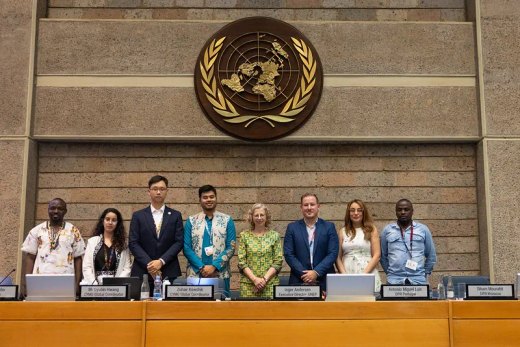
What happened in the room & how CYMG contributed
Negotiations revealed differing views on how far MEA coordination should go. Some Member States supported stronger alignment across MEAs to reduce reporting burdens and improve efficiency, while others emphasized the need to protect MEA mandates and national sovereignty.
The room broadly welcomed the resolution’s intention to improve coherence among MEAs, especially around harmonized reporting, aligned implementation cycles, and reduced administrative burdens. Several delegations, including youth, recognized the value of strengthening cooperation and data systems to address fragmentation. Towards this end, CYMG delegates’ interventions highlighted that the text needed to be more specific; the draft lacked a concrete mechanism to drive real coordination, with the risk of becoming another lofty encouragement rather than a transformative action step.
Debates centered on UNEP’s role in providing support for reporting tools and coordination mechanisms, the UN Environment Management Group (EMG), and the need to avoid creating new obligations or perceived interference in national sovereignty. The resolution was sensitive because it touched on institutional mandates, national sovereignty, and the political implications of reshaping coordination across MEAs. Some delegations were concerned that stronger coherence–whether through harmonized reporting or a more active UNEP and EMG–might be perceived as encroaching on the authority of MEA Conference of the Parties (COPs). Others underscored the resource implications of new coordination tools, especially for countries with limited capacity.
Evaluating the UNEA-7 outcome
There is an urgent need to increase synergies across MEAs and this resolution, in short, does not go far enough in doing so.
Consistent with CYMG’s initial concerns, the final text consists of broad encouragements rather than concrete commitments. To be effective in its own goals, the resolution could have been more ambitious, operational, and inclusive of youth and other stakeholders. The resolution lacks specific mechanisms to guide proposed reforms, such as a task force or clear roadmap, as CYMG urged. Especially given the UNEA-7 resolution on leveraging Artificial Intelligence for environmental solutions, and the ever-increasing number of MEAs (est. 250-500+), now is a particularly opportune moment to harness technology towards improving interoperability–but the current resolution might not be up to the challenge.
Additionally, CYMG called for institutionalizing youth participation and strengthening science‑policy collaboration, both of which are unaddressed in the final resolution. Ideally, this tool would embed youth and stakeholder roles more structurally–through involvement in national reporting, MEA Day dialogues, and UNEP‑led coordination platforms–helping anchor intergenerational equity and inclusive governance as core principles of strengthened MEA coherence.
Why UNEA and Nairobi matter here
The entire world sits together to shape the future of environmental governance at UNEA, meaning it offers unique political visibility, legitimacy, and a space for countries, youth, and civil society to push for a fairer and more coherent multilateral system.
Nairobi, as UNEP’s home, is the center of environmental coordination, technical expertise, and day‑to‑day collaboration across MEAs. Advancing this resolution here reinforces UNEA and UNEP’s roles in connecting global agreements, supporting countries, and ensuring that efforts like the Kunming‑Montreal Framework are implemented in a more aligned, people‑centered way.
What this means for youth
For youth, this resolution creates meaningful entry points to engage where policy coherence, accountability, and implementation meet. While it does not establish new youth‑specific bodies, it reinforces several forums where young people can contribute in concrete ways, such as national MEA reporting processes, UNEP‑supported capacity‑building platforms, and the expanded MEA Day, which the resolution positions as a space for knowledge exchange and science‑policy dialogue. Youth can also contribute to monitoring and reporting processes, and bring technical expertise in data, digital tools, and systems thinking.
Youth‑led organizations stand to play an important role connecting climate, biodiversity, and pollution agendas, ensuring implementation reflects the interconnected realities communities face. There is a clear opportunity for youth leadership in strengthening transparency, inclusive participation, and innovative coordination at national and local levels.
Bottom line
The final text of the MEAs resolution constitutes a notable step forward, even if it remains more “pragmatic” in scope than ambitious and transformative. At a minimum, it elevates and formally acknowledges the urgent need for stronger coordination among MEAs–an issue long recognized but rarely addressed with this level of political clarity. Further, the text reinforces UNEP’s role in supporting countries, a necessary step for a system that has struggled for years with fragmentation and uneven implementation.
This said, the resolution stops short of establishing concrete mechanisms or timelines, limiting its immediate impact. For youth, this underscores both the opening and the work ahead: advocating for operational follow‑through, pushing for structured processes such as task forces or roadmaps, and ensuring that future negotiations embed intergenerational equity and inclusive governance at their core.